About FenixPyre

About FenixPyre

About FenixPyre

Elegant Innovation for
Data Security

Elegant Innovation for Data Security

At FenixPyre, we’re redefining how organizations protect what matters most - their data.

In a world where cyber threats are more sophisticated, insider risks more subtle, and data more mobile than ever, traditional DLP isn’t enough. That’s why we built FenixPyre: a file-centric security platform that safeguards sensitive information no matter where it travels, who accesses it, or how it’s shared.

Our mission is simple - make enterprise-grade data protection effortless, intelligent, and scalable. From ransomware prevention to insider threat mitigation and third-party risk control, we help businesses take back control of their data with solutions that are as powerful as they are easy to deploy.

Rooted in innovation and designed for today’s hybrid, cloud-first world, FenixPyre enables organizations to move fast, stay compliant, and operate with confidence - without ever compromising on security.

Whether you’re securing an enterprise or a growing startup, FenixPyre helps you protect every file, everywhere - instantly.

At FenixPyre, we’re redefining how organizations protect what matters most - their data.

In a world where cyber threats are more sophisticated, insider risks more subtle, and data more mobile than ever, traditional DLP isn’t enough. That’s why we built FenixPyre: a file-centric security platform that safeguards sensitive information no matter where it travels, who accesses it, or how it’s shared.

Our mission is simple - make enterprise-grade data protection effortless, intelligent, and scalable. From ransomware prevention to insider threat mitigation and third-party risk control, we help businesses take back control of their data with solutions that are as powerful as they are easy to deploy.

Rooted in innovation and designed for today’s hybrid, cloud-first world, FenixPyre enables organizations to move fast, stay compliant, and operate with confidence - without ever compromising on security.

Whether you’re securing an enterprise or a growing startup, FenixPyre helps you protect every file, everywhere - instantly.

At FenixPyre, we’re redefining how organizations protect what matters most - their data.

In a world where cyber threats are more sophisticated, insider risks more subtle, and data more mobile than ever, traditional DLP isn’t enough. That’s why we built FenixPyre: a file-centric security platform that safeguards sensitive information no matter where it travels, who accesses it, or how it’s shared.

Our mission is simple - make enterprise-grade data protection effortless, intelligent, and scalable. From ransomware prevention to insider threat mitigation and third-party risk control, we help businesses take back control of their data with solutions that are as powerful as they are easy to deploy.

Rooted in innovation and designed for today’s hybrid, cloud-first world, FenixPyre enables organizations to move fast, stay compliant, and operate with confidence - without ever compromising on security.

Whether you’re securing an enterprise or a growing startup, FenixPyre helps you protect every file, everywhere - instantly.

Meet our leadership team.

Harihara Varma Indukuri

CTO and Co-Founder

Harihara Varma Indukuri

CTO and Co-Founder

Harihara Varma Indukuri

CTO and Co-Founder

C. Emre Koksal

Chief Scientist, and Co-Founder

C. Emre Koksal

Chief Scientist, and Co-Founder

C. Emre Koksal

Chief Scientist, and Co-Founder

Chris Dailey

Chief Revenue Officer

Chris Dailey

Chief Revenue Officer

Chris Dailey

Chief Revenue Officer

Danny Bloomfield

VP Enterprise Sales

Danny Bloomfield

VP Enterprise Sales

Danny Bloomfield

VP Enterprise Sales

Our
Vision

Our Vision

At FenixPyre, our vision is to create a digital world where data remains secure, intelligent, and in control - no matter where it goes.

We believe the future of cybersecurity lies in protecting information at its source: the data. As organizations embrace cloud, mobility, and distributed collaboration, traditional perimeter-based defenses fall short. FenixPyre envisions a paradigm shift—one where security follows the data, adapting in real time and empowering teams to operate freely without sacrificing protection.

We’re not just building security tools - we’re shaping the next generation of resilient digital infrastructure, one secure file at a time.

At FenixPyre, our vision is to create a digital world where data remains secure, intelligent, and in control - no matter where it goes.

We believe the future of cybersecurity lies in protecting information at its source: the data. As organizations embrace cloud, mobility, and distributed collaboration, traditional perimeter-based defenses fall short. FenixPyre envisions a paradigm shift—one where security follows the data, adapting in real time and empowering teams to operate freely without sacrificing protection.

We’re not just building security tools - we’re shaping the next generation of resilient digital infrastructure, one secure file at a time.

At FenixPyre, our mission is to protect what matters most - your data-wherever it lives, moves, or is shared.

We are building a future where sensitive data is safeguarded at the file level - regardless of where it travels, who accesses it, or how it’s shared. Our platform empowers organizations to prevent ransomware, neutralize insider threats, and enforce third-party governance, all without disrupting productivity.

Designed for simplicity, performance, and adaptability, FenixPyre addresses the escalating demands of data protection with a solution that’s cloud-native, frictionless, and built for growth. We’re not just securing information - we’re enabling digital trust at scale.

At FenixPyre, our mission is to protect what matters most - your data-wherever it lives, moves, or is shared.

We are building a future where sensitive data is safeguarded at the file level - regardless of where it travels, who accesses it, or how it’s shared. Our platform empowers organizations to prevent ransomware, neutralize insider threats, and enforce third-party governance, all without disrupting productivity.

Designed for simplicity, performance, and adaptability, FenixPyre addresses the escalating demands of data protection with a solution that’s cloud-native, frictionless, and built for growth. We’re not just securing information - we’re enabling digital trust at scale.

Our
Mission

Our Mission

Our
Values

Our Values

Quality

We are committed to providing excellent data security software for our customers, so that data is never leaked.

We are committed to providing excellent data security software for our customers, so that data is never leaked.

We are committed to providing excellent data security software for our customers, so that data is never leaked.

Innovation

We believe technology is a force for good, that can help make our lives easier. That’s why we are dedicated to creating meaningful products that allow organizations to achieve their full potential.

Simplicity

We are dedicated to providing easy-to-use solutions so that data security is never a hassle.


We are dedicated to providing easy-to-use solutions so that data security is never a hassle.

We are dedicated to providing easy-to-use solutions so that data security is never a hassle.

Continuous Learning

We strive to learn new things every day. We believe that learning continues outside of the classroom.


We strive to learn new things every day. We believe that learning continues outside of the classroom.

We strive to learn new things every day. We believe that learning continues outside of the classroom.

50+ Patent Claims

Millions of files protected

50+ Patent Claims

Millions of files protected

50+ Patent Claims

Millions of files protected

Award Winning
Platform

Award Winning
Platform

Cybersecurity Excellence Award

Cybersecurity Excellence Award

CRN Tech Innovator Finalist, Zero Trust Security

CRN Tech Innovator Finalist, Zero Trust Security

Finalist MIT Sloan CIO Summit

Finalist MIT Sloan CIO Summit

USAF ABMS


USAF ABMS

USAF ABMS


Latest News

Data Protection

Dec 24, 2025

If Your Files Decrypt for Attackers, You Do Not Have Data Security

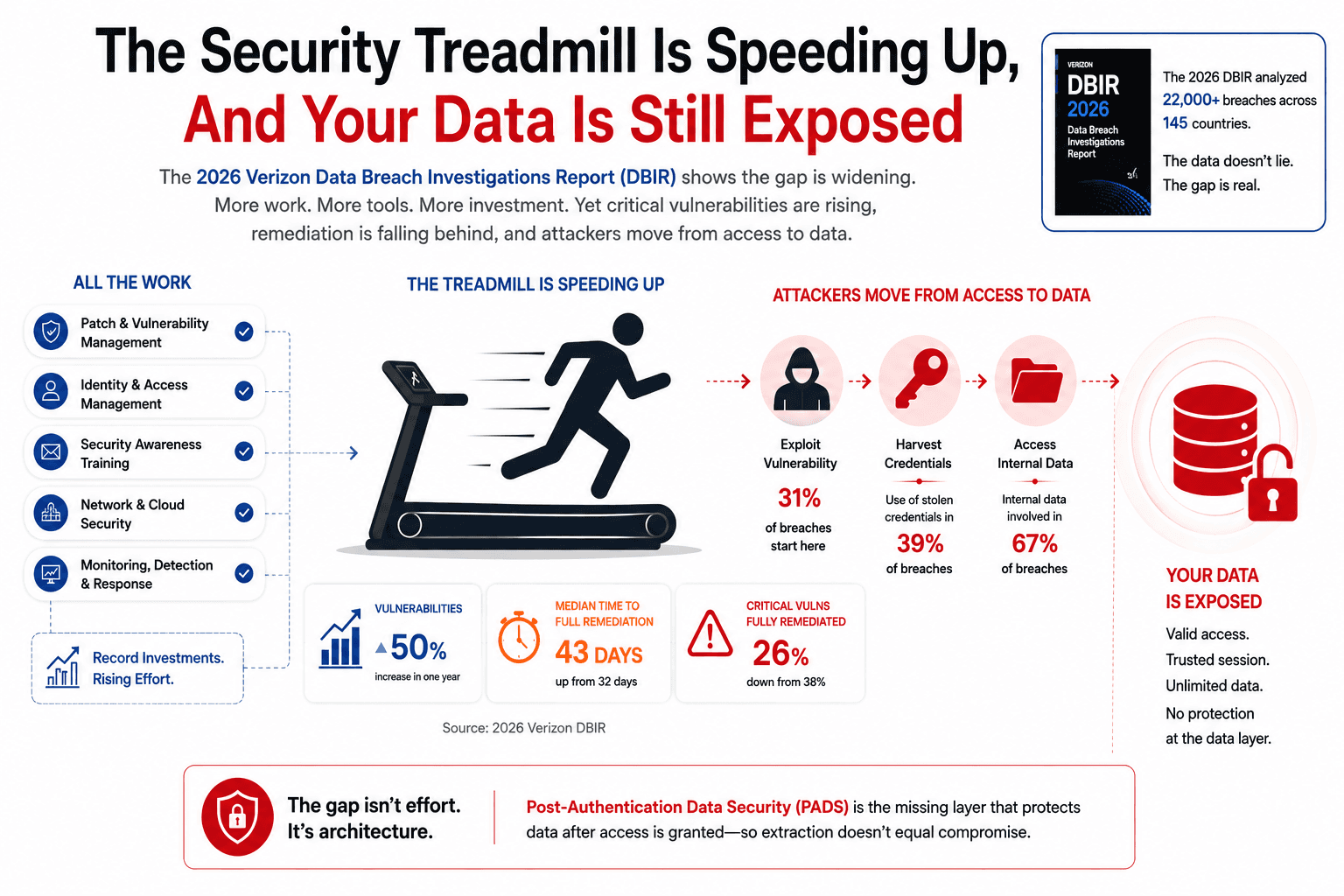
Most security strategies collapse at the same point. The moment an attacker logs in.

This is the uncomfortable reality many executives have not been forced to confront. Once valid credentials are compromised, most environments behave exactly as designed. Files decrypt. Applications open. Data becomes readable, copyable, and transferable.

And let’s face the bottom-line truth: More than 80% of data theft happens after attackers log in with valid credentials. 

At that moment, the organization does not have a cybersecurity problem. It has a data protection failure.

Authenticated Access Is the Breaking Point

The modern threat model does not center on breaking through firewalls. Attackers increasingly enter through the front door using stolen, phished, guessed, or misused credentials. This is well documented. Most data theft now occurs after attackers authenticate successfully. Perhaps you and your team have already experienced this.

When that happens, perimeter defenses fade into the background. Identity controls validate the login. Endpoint tools allow normal activity. Encryption at rest quietly decrypts files for the authenticated user.

From the attacker’s perspective, the system is cooperating. They’re free to steal data at will.

If your files decrypt automatically for anyone who logs in, then your security strategy assumes trust at the exact moment trust has been violated.

Why Traditional Security Fails Here

Most security investments are designed to prevent intrusion or detect abnormal behavior. Firewalls filter traffic. MFA reduces unauthorized access. SIEM and XDR platforms monitor activity. Backups restore systems after an incident.

None of these controls are designed to stop an authenticated attacker from reading a file.

Disk encryption protects storage devices when they are powered off or removed. It does nothing once the operating system is running and a user is logged in. Data loss prevention tools rely on classification accuracy and detection timing, both of which routinely fail under real-world conditions. Detection tools alert after activity occurs, not before data leaves.

These controls were built for a world where stopping entry was enough. 

That world no longer exists.

The Leadership Blind Spot

Executives are often told that their data is encrypted. They hear this phrase repeatedly in vendor briefings, audit reports, and internal updates. 

The problem is that the word “encryption” is doing too much work.

Encryption that disappears at login does not protect data. It protects infrastructure.

This distinction is rarely made explicit in executive conversations. Security teams report on controls they manage rather than outcomes leadership cares about. Boards review dashboards that show coverage and maturity while never being asked a defining question: If someone logs in with valid credentials, what stops them from stealing our data?

In most organizations, the honest answer is nothing.

This is not because teams are incompetent. It is because leadership has not demanded a different standard.

What Data Security Actually Means

Real data security does not depend on just keeping attackers out. It assumes they will get in.

In that model, the goal evolves. Systems may be accessed. Accounts may be compromised. Data must remain protected anyway.

This requires encryption that persists beyond the perimeter and beyond login. Files must remain unreadable unless specific conditions are met. Approved user. Approved device. Approved context. Approved time.

If those conditions fail, the data stays encrypted.

When files are exfiltrated, they carry their protection with them. When credentials are abused, access does not automatically equal exposure. When systems fail, confidentiality does not fail with them.

This is what it means to deny value to an attacker.

Why Leadership Must Demand This Standard

Security teams optimize for what leadership measures. If success is defined as uptime, compliance, and recovery speed, then investments will follow those goals.

If success is defined as preventing data theft after compromise, strategies change.

This shift does not happen organically. It requires executive pressure. Boards must demand clarity on data exposure. CEOs must ask how data is protected after login. CFOs must understand that recovery without confidentiality is still a loss.

Until leadership forces this conversation, security programs will continue to excel at protecting systems while data walks out the door.

This Is a Solvable Problem

The most dangerous misconception in cybersecurity today is that preventing data theft after compromise is impossible. It is not.

File-level, data-centric protection already exists. It has matured. It integrates with modern identity systems. It operates across cloud, on-premise, and legacy environments. It does not require users to change how they work.

What it requires is leadership willingness to adopt a new definition of security.

Organizations that make this shift gain a structural advantage. They reduce regulatory exposure. They limit the blast radius of breaches. They remove the attacker’s incentive by making stolen data unusable.

They also gain something less tangible but equally important: Control.

Data Protection

Dec 24, 2025

If Your Files Decrypt for Attackers, You Do Not Have Data Security

Most security strategies collapse at the same point. The moment an attacker logs in.

This is the uncomfortable reality many executives have not been forced to confront. Once valid credentials are compromised, most environments behave exactly as designed. Files decrypt. Applications open. Data becomes readable, copyable, and transferable.

And let’s face the bottom-line truth: More than 80% of data theft happens after attackers log in with valid credentials. 

At that moment, the organization does not have a cybersecurity problem. It has a data protection failure.

Authenticated Access Is the Breaking Point

The modern threat model does not center on breaking through firewalls. Attackers increasingly enter through the front door using stolen, phished, guessed, or misused credentials. This is well documented. Most data theft now occurs after attackers authenticate successfully. Perhaps you and your team have already experienced this.

When that happens, perimeter defenses fade into the background. Identity controls validate the login. Endpoint tools allow normal activity. Encryption at rest quietly decrypts files for the authenticated user.

From the attacker’s perspective, the system is cooperating. They’re free to steal data at will.

If your files decrypt automatically for anyone who logs in, then your security strategy assumes trust at the exact moment trust has been violated.

Why Traditional Security Fails Here

Most security investments are designed to prevent intrusion or detect abnormal behavior. Firewalls filter traffic. MFA reduces unauthorized access. SIEM and XDR platforms monitor activity. Backups restore systems after an incident.

None of these controls are designed to stop an authenticated attacker from reading a file.

Disk encryption protects storage devices when they are powered off or removed. It does nothing once the operating system is running and a user is logged in. Data loss prevention tools rely on classification accuracy and detection timing, both of which routinely fail under real-world conditions. Detection tools alert after activity occurs, not before data leaves.

These controls were built for a world where stopping entry was enough. 

That world no longer exists.

The Leadership Blind Spot

Executives are often told that their data is encrypted. They hear this phrase repeatedly in vendor briefings, audit reports, and internal updates. 

The problem is that the word “encryption” is doing too much work.

Encryption that disappears at login does not protect data. It protects infrastructure.

This distinction is rarely made explicit in executive conversations. Security teams report on controls they manage rather than outcomes leadership cares about. Boards review dashboards that show coverage and maturity while never being asked a defining question: If someone logs in with valid credentials, what stops them from stealing our data?

In most organizations, the honest answer is nothing.

This is not because teams are incompetent. It is because leadership has not demanded a different standard.

What Data Security Actually Means

Real data security does not depend on just keeping attackers out. It assumes they will get in.

In that model, the goal evolves. Systems may be accessed. Accounts may be compromised. Data must remain protected anyway.

This requires encryption that persists beyond the perimeter and beyond login. Files must remain unreadable unless specific conditions are met. Approved user. Approved device. Approved context. Approved time.

If those conditions fail, the data stays encrypted.

When files are exfiltrated, they carry their protection with them. When credentials are abused, access does not automatically equal exposure. When systems fail, confidentiality does not fail with them.

This is what it means to deny value to an attacker.

Why Leadership Must Demand This Standard

Security teams optimize for what leadership measures. If success is defined as uptime, compliance, and recovery speed, then investments will follow those goals.

If success is defined as preventing data theft after compromise, strategies change.

This shift does not happen organically. It requires executive pressure. Boards must demand clarity on data exposure. CEOs must ask how data is protected after login. CFOs must understand that recovery without confidentiality is still a loss.

Until leadership forces this conversation, security programs will continue to excel at protecting systems while data walks out the door.

This Is a Solvable Problem

The most dangerous misconception in cybersecurity today is that preventing data theft after compromise is impossible. It is not.

File-level, data-centric protection already exists. It has matured. It integrates with modern identity systems. It operates across cloud, on-premise, and legacy environments. It does not require users to change how they work.

What it requires is leadership willingness to adopt a new definition of security.

Organizations that make this shift gain a structural advantage. They reduce regulatory exposure. They limit the blast radius of breaches. They remove the attacker’s incentive by making stolen data unusable.

They also gain something less tangible but equally important: Control.

Data Protection

Dec 15, 2025

Helping Leaders Understand Their Blind Spot Around Data Security: Advice From an Operator

Helping Leaders Understand Their Blind Spot Around Data Security: Advice From an Operator

Defending a company’s data, IP, and proprietary information requires a level of alignment between the C-Suite and IT leadership that most organizations simply don’t have. We’re long past the era where executives and technical teams can afford to speak different languages and only reach mutual understanding after a breach has occurred.

Attackers are outpacing companies because they’re focused, and their targets aren’t.

As Kevin Schwartz, CISSP, Cybersecurity Expert, put it in our recent conversation: “Executives tend to become interested in the details of cybersecurity post-breach or when news of a competitor’s breach has hit the news. Unfortunately, the typical dialogue around data security is one where leadership is looking for the general affirmation to the question ‘We’re secure, right?’”

Like any problem a company wants to solve, it is about priorities and trade offs. 

Asking a question as general as “Are we secure?” is of the same value as asking your head of sales, “We are talking to people, right?” The core value to the communication is in a specific level of detail. 

Nowhere is this communication gap more dangerous than in the protection of sensitive data: the company’s actual crown jewels.

Here’s the quickest way to test whether your organization has the right conversation happening internally:

Ask your head of IT or cybersecurity: If someone is inside our network using a valid username and password, can our sensitive data be stolen by an employee or a bad actor?

This single question exposes the heart of today’s security crisis. More than 80% of data theft occurs after an attacker has obtained valid credentials.

And in most organizations, the existing stack simply cannot stop exfiltration in this scenario.

Fixing the Communication Gap Around Data Security

The core issue is the communication gap around how data is actually stolen and what today’s security stack can (and cannot) defend against. 

Traditional security architecture is focused on keeping attackers out: perimeter defenses, hardened endpoints, identity controls, and in some cases, early-stage Zero Trust. These are valuable, complex systems that are often implemented under resource constraints.

But they’re designed for an older threat model.

These days, it’s the equivalent of installing reinforced doors and bulletproof windows while the intruder is already sitting on your couch with a working key.

Remember, 80% of data theft occurs when the bad actors are inside. This means that the bad guys are very successful at getting inside and getting past all your perimeter security. If they want to get inside they will. Almost half of data theft and loss is due to employees or employees on their way out of the company. The other half is bad actors finding one of many ways to steal valid credentials and use them to steal your data. 

The enemy is inside your perimeter most of the time and this is the little dirty secret that IT teams and C-suite aren’t communicating on. 

It is this gap of communication that the bad guys are able to exploit. 

Leadership is not asking the question they are afraid to hear the answer to, and IT and cybersecurity teams are not making it clear that the data security emperor has no clothes. 

Data Encryption and Its Misunderstanding

Schwartz puts it simply: the conversation has changed. 

“Every [sales] quote I bring to leadership starts with encryption,” he says. But between self-encrypting drives, FIPS encryption, and so on, encryption is already everywhere in the ecosystem. The problem is that few at the executive level understand the difference between that and protecting the data itself

This is why the new generation of CISOs, IT directors, and cyber operators increasingly lead with file-level, data-centric protection:

1. Because breaches don’t stay inside the perimeter

Most modern breaches begin with legitimate credentials. Once an attacker logs in, perimeter tools don’t matter. As Schwartz frames it, “Hackers don’t stop where your access stops. They pivot until they find something worth stealing.”

Data-level encryption flips that model: even if credentials are compromised, the files remain unreadable unless the device, identity, and key all align.

2. Because executive teams want clear ROI (not jargon)

Security leaders are constantly selling their strategy internally. And “We need more encryption” no longer lands. It sounds redundant. File-level protection gives CISOs a different, clearer narrative: We’re protecting the asset (not just the system).

That framing makes spending far easier to justify in rooms full of CEOs, CFOs, and boards.

3. Because legacy systems won’t get modern overnight

This is one of Schwartz’s biggest warnings. Many organizations run on equipment, operating systems, or OT infrastructure that can’t be fully patched or modernized.

“You can’t secure Windows 2000,” Schwartz says. “But you can secure the data coming off it.”

Data-centric encryption is the only practical path forward for environments that can’t be rebuilt from scratch.

4. Because AI-accelerated attacks change the timeline

Exfiltration now happens within minutes of initial access. There’s no detection window left. When speed favors the attacker, only protections that travel with the data - and lock automatically - can slow the blast radius.

5. Because it fits the compensating-controls mindset

Modern security isn’t one control - it’s a stack of compensating protections. File-level encryption strengthens everything around it: identity, endpoint defense, OT segmentation, even basic hygiene.

“It’s not impossible to bypass,” Schwartz says. “Nothing is. But it raises the difficulty so high that an attacker will move on.”

That’s the definition of a strong compensating control.

6. Because it lets security leaders deliver what the business actually needs

Every executive says the same thing in every budget meeting: Keep us safe. Don’t slow us down.

Data-centric encryption is one of the few controls that improves security without increasing friction. Users operate normally. Workflows stay intact. Only attackers encounter the locked door.

The Leaders Who Win Will Lead With Data

The organizations that succeed against the next data leak or ransomware attack will be the ones able to answer a single, defining question:

How is our data protected when the attacker is already inside the network using valid credentials?

Perimeter tools still matter. Identity still matters. Basic hygiene still matters. But none of it is enough if critical files can be opened, copied, or exported the moment someone logs in with a stolen username and password.

That’s why the next generation of CIOs, CISOs, and IT directors are recalibrating their strategies around data-centric protection. It’s a structural shift driven by credential-based attacks, aging infrastructure, AI-accelerated threat speed, and the simple reality that a company’s most valuable asset is now digital.

And in a world where breaches are inevitable, the organizations that thrive will be the ones whose data remains unreadable, unusable, and inaccessible to anyone who shouldn’t have it.

Data Protection

Dec 15, 2025

Helping Leaders Understand Their Blind Spot Around Data Security: Advice From an Operator

Helping Leaders Understand Their Blind Spot Around Data Security: Advice From an Operator

Defending a company’s data, IP, and proprietary information requires a level of alignment between the C-Suite and IT leadership that most organizations simply don’t have. We’re long past the era where executives and technical teams can afford to speak different languages and only reach mutual understanding after a breach has occurred.

Attackers are outpacing companies because they’re focused, and their targets aren’t.

As Kevin Schwartz, CISSP, Cybersecurity Expert, put it in our recent conversation: “Executives tend to become interested in the details of cybersecurity post-breach or when news of a competitor’s breach has hit the news. Unfortunately, the typical dialogue around data security is one where leadership is looking for the general affirmation to the question ‘We’re secure, right?’”

Like any problem a company wants to solve, it is about priorities and trade offs. 

Asking a question as general as “Are we secure?” is of the same value as asking your head of sales, “We are talking to people, right?” The core value to the communication is in a specific level of detail. 

Nowhere is this communication gap more dangerous than in the protection of sensitive data: the company’s actual crown jewels.

Here’s the quickest way to test whether your organization has the right conversation happening internally:

Ask your head of IT or cybersecurity: If someone is inside our network using a valid username and password, can our sensitive data be stolen by an employee or a bad actor?

This single question exposes the heart of today’s security crisis. More than 80% of data theft occurs after an attacker has obtained valid credentials.

And in most organizations, the existing stack simply cannot stop exfiltration in this scenario.

Fixing the Communication Gap Around Data Security

The core issue is the communication gap around how data is actually stolen and what today’s security stack can (and cannot) defend against. 

Traditional security architecture is focused on keeping attackers out: perimeter defenses, hardened endpoints, identity controls, and in some cases, early-stage Zero Trust. These are valuable, complex systems that are often implemented under resource constraints.

But they’re designed for an older threat model.

These days, it’s the equivalent of installing reinforced doors and bulletproof windows while the intruder is already sitting on your couch with a working key.

Remember, 80% of data theft occurs when the bad actors are inside. This means that the bad guys are very successful at getting inside and getting past all your perimeter security. If they want to get inside they will. Almost half of data theft and loss is due to employees or employees on their way out of the company. The other half is bad actors finding one of many ways to steal valid credentials and use them to steal your data. 

The enemy is inside your perimeter most of the time and this is the little dirty secret that IT teams and C-suite aren’t communicating on. 

It is this gap of communication that the bad guys are able to exploit. 

Leadership is not asking the question they are afraid to hear the answer to, and IT and cybersecurity teams are not making it clear that the data security emperor has no clothes. 

Data Encryption and Its Misunderstanding

Schwartz puts it simply: the conversation has changed. 

“Every [sales] quote I bring to leadership starts with encryption,” he says. But between self-encrypting drives, FIPS encryption, and so on, encryption is already everywhere in the ecosystem. The problem is that few at the executive level understand the difference between that and protecting the data itself

This is why the new generation of CISOs, IT directors, and cyber operators increasingly lead with file-level, data-centric protection:

1. Because breaches don’t stay inside the perimeter

Most modern breaches begin with legitimate credentials. Once an attacker logs in, perimeter tools don’t matter. As Schwartz frames it, “Hackers don’t stop where your access stops. They pivot until they find something worth stealing.”

Data-level encryption flips that model: even if credentials are compromised, the files remain unreadable unless the device, identity, and key all align.

2. Because executive teams want clear ROI (not jargon)

Security leaders are constantly selling their strategy internally. And “We need more encryption” no longer lands. It sounds redundant. File-level protection gives CISOs a different, clearer narrative: We’re protecting the asset (not just the system).

That framing makes spending far easier to justify in rooms full of CEOs, CFOs, and boards.

3. Because legacy systems won’t get modern overnight

This is one of Schwartz’s biggest warnings. Many organizations run on equipment, operating systems, or OT infrastructure that can’t be fully patched or modernized.

“You can’t secure Windows 2000,” Schwartz says. “But you can secure the data coming off it.”

Data-centric encryption is the only practical path forward for environments that can’t be rebuilt from scratch.

4. Because AI-accelerated attacks change the timeline

Exfiltration now happens within minutes of initial access. There’s no detection window left. When speed favors the attacker, only protections that travel with the data - and lock automatically - can slow the blast radius.

5. Because it fits the compensating-controls mindset

Modern security isn’t one control - it’s a stack of compensating protections. File-level encryption strengthens everything around it: identity, endpoint defense, OT segmentation, even basic hygiene.

“It’s not impossible to bypass,” Schwartz says. “Nothing is. But it raises the difficulty so high that an attacker will move on.”

That’s the definition of a strong compensating control.

6. Because it lets security leaders deliver what the business actually needs

Every executive says the same thing in every budget meeting: Keep us safe. Don’t slow us down.

Data-centric encryption is one of the few controls that improves security without increasing friction. Users operate normally. Workflows stay intact. Only attackers encounter the locked door.

The Leaders Who Win Will Lead With Data

The organizations that succeed against the next data leak or ransomware attack will be the ones able to answer a single, defining question:

How is our data protected when the attacker is already inside the network using valid credentials?

Perimeter tools still matter. Identity still matters. Basic hygiene still matters. But none of it is enough if critical files can be opened, copied, or exported the moment someone logs in with a stolen username and password.

That’s why the next generation of CIOs, CISOs, and IT directors are recalibrating their strategies around data-centric protection. It’s a structural shift driven by credential-based attacks, aging infrastructure, AI-accelerated threat speed, and the simple reality that a company’s most valuable asset is now digital.

And in a world where breaches are inevitable, the organizations that thrive will be the ones whose data remains unreadable, unusable, and inaccessible to anyone who shouldn’t have it.

Data Protection

Nov 17, 2025

Cybersecurity Resilience: Have you been focusing on the right things?

Walk into any modern business operation and you’ll see layers of protection. You’ll encounter firewalls, MFA, VPNs, DLP, endpoint detection, server hardening, SIEMs, offline backups, the works. Most companies have spent years building strong defenses. 

But here’s the hard truth: Those layers aren’t enough anymore.

“We’ve built a lot of resiliency in cybersecurity - identity resiliency, endpoint resiliency, technology resiliency,” says Gary Clark, Principal Cybersecurity Consultant at Yearling Solutions. “But where we haven’t spent enough time is with data resiliency.”

That missing layer - protecting the data itself - is what’s leaving even well-funded security programs vulnerable.

The “Pre-Boom” Mindset

Clark uses a term that resonates with anyone who’s been through an incident response: pre-boom and post-boom.

  • Pre-boom covers everything that happens before an attack: prevention, detection, and containment.

  • Post-boom is what happens after the breach, when the attacker already has a stronghold and data begins to move out of the network.

“We’ve conditioned ourselves to think that if we implement all of the Pre-boom controls to protect the environment, we’ll have the resiliency we need to survive a ransomware attack,” Clark says.

But have we, as cybersecurity practitioners, been overly focused on building resilience around the controls protecting the crown jewels - instead of building resilience into the jewels themselves?

A simple analogy brings this into focus: banks didn’t stop robberies by reinforcing the glass. They added dye packs to the cash. Even if the money is stolen, it’s permanently marked - rendered useless to the thief.

It’s the same with data. Protecting the network and systems alone doesn’t guarantee protecting what’s inside.

Exfiltration Happens Faster Than Detection

Attackers don’t wait anymore. “Now as soon as they get an account, they’re exfiltrating data,” Clark explains. “You might be lucky if it’s a low-privilege account, but even then, they’re pulling internal data immediately and then moving to get more accounts and ultimately elevating to more privileged ones.”

The bottom line is that most breaches start with a legitimate username and password, either through an internal threat or through a classic phishing scam (the sort of email racket that’s only becoming more pervasive in B2B spaces). 

Tools, like DLP and zero trust, can help reduce the blast radius, but none can stop exfiltration 100%. Once data leaves your network, it’s out of your hands unless you have data resilience. 

What “Encryption Everywhere” Really Means

Encryption has been around for decades. But too often, it stops at the network boundary - protecting data at rest and in transit, but not in use.

Clark describes a more intelligent approach: “You have to understand the context of how the data is being used and whether  it’s fallen into adverse hands. You don’t want to allow it to be unencrypted if it’s in the wrong place.”

That’s the core of file-centric encryption; each file carries its own logic. It knows who can open it, on what device, and under what conditions. If a file leaves your network or ends up on an unapproved device, it stays encrypted. Ciphertext. Unreadable. Even outright unusable, like the cash with the dye packs the thief stole from the bank in our earlier metaphor.

That capability, offered through solutions like FenixPyre, allows manufacturers to enforce “encryption everywhere,” a model where data protection travels with the file itself, not the network.

Encryption Everywhere: What It Looks Like in Practice

​​Manufacturing

From CAD designs to production schedules, manufacturing data moves constantly between plants, vendors, and design partners. A single compromised file can expose proprietary processes or customer information. With file-centric encryption, each file carries its own protection logic: It can only be opened by approved users, on approved devices, in approved locations. That means intellectual property stays safe, even when it travels far beyond the shop floor.

Health Care

Hospitals and labs exchange enormous volumes of patient data daily - test results, insurance records, diagnostic images. With file-centric encryption, every document carries its own protection. Even if it’s shared across systems or accessed on an unapproved device, the data remains encrypted and unreadable.

Finance

Trading firms, banks, and advisors all rely on shared documents full of sensitive client information. File-level encryption ensures that even if a user’s credentials are compromised, the underlying data stays secure. This protects not just the customer, but the firm’s reputation.

Aerospace + Defense

When engineering drawings or CAD files leave your organization, they shouldn’t lose their protection. File-centric encryption enforces access controls that travel with the data, so only approved users, devices, and locations can ever open it. Everyone else sees ciphertext.

Energy + Utilities

Operational data flows constantly between utilities, contractors, and regulators. File-level encryption gives these organizations the power to revoke access instantly, protecting critical infrastructure even if a partner or supplier suffers a breach.

Frictionless by Design

No cybersecurity strategy works if employees can’t do their jobs or customers can’t access services they’ve purchased.

“Users just want to do their work,” Clark says. “Cyber tools should be as frictionless as possible.”

In practice, that means embedding security quietly into normal workflows. A user should never have to change how they save, send, or access a file unless they’re breaking the rules. Then, and only then, the file simply won’t open.

That’s how file-centric encryption succeeds where traditional security fails: it makes protection invisible to users but absolute against adversaries.

The Bottom-Line Business Reality

For most businesses operating at the scale of the manufacturing industry or the health care space or other sprawling markets, the stakes are especially high. Intellectual property, equipment configurations, process documentation–all of it is valuable to competitors and attackers alike.

Even small and mid-sized companies can be targets. 

As Clark puts it: “We’re all struggling with the same thing. Whether you have a lot of resources or just a few, focus on what the attacker actually want - your data and your operations. Build resilience into those two things and you’re in a much better place, no matter what your cybersecurity budget is.”

That’s the mindset shift Industry 4.0 demands: less focus on building higher walls, more focus on protecting what’s inside them.

Because at some point, your business’s digital environment probably will be breached. What happens next - whether your data is stolen or stays safe - depends on how ready you are for the post-boom.

Data Protection

Nov 17, 2025

Cybersecurity Resilience: Have you been focusing on the right things?

Walk into any modern business operation and you’ll see layers of protection. You’ll encounter firewalls, MFA, VPNs, DLP, endpoint detection, server hardening, SIEMs, offline backups, the works. Most companies have spent years building strong defenses. 

But here’s the hard truth: Those layers aren’t enough anymore.

“We’ve built a lot of resiliency in cybersecurity - identity resiliency, endpoint resiliency, technology resiliency,” says Gary Clark, Principal Cybersecurity Consultant at Yearling Solutions. “But where we haven’t spent enough time is with data resiliency.”

That missing layer - protecting the data itself - is what’s leaving even well-funded security programs vulnerable.

The “Pre-Boom” Mindset

Clark uses a term that resonates with anyone who’s been through an incident response: pre-boom and post-boom.

  • Pre-boom covers everything that happens before an attack: prevention, detection, and containment.

  • Post-boom is what happens after the breach, when the attacker already has a stronghold and data begins to move out of the network.

“We’ve conditioned ourselves to think that if we implement all of the Pre-boom controls to protect the environment, we’ll have the resiliency we need to survive a ransomware attack,” Clark says.

But have we, as cybersecurity practitioners, been overly focused on building resilience around the controls protecting the crown jewels - instead of building resilience into the jewels themselves?

A simple analogy brings this into focus: banks didn’t stop robberies by reinforcing the glass. They added dye packs to the cash. Even if the money is stolen, it’s permanently marked - rendered useless to the thief.

It’s the same with data. Protecting the network and systems alone doesn’t guarantee protecting what’s inside.

Exfiltration Happens Faster Than Detection

Attackers don’t wait anymore. “Now as soon as they get an account, they’re exfiltrating data,” Clark explains. “You might be lucky if it’s a low-privilege account, but even then, they’re pulling internal data immediately and then moving to get more accounts and ultimately elevating to more privileged ones.”

The bottom line is that most breaches start with a legitimate username and password, either through an internal threat or through a classic phishing scam (the sort of email racket that’s only becoming more pervasive in B2B spaces). 

Tools, like DLP and zero trust, can help reduce the blast radius, but none can stop exfiltration 100%. Once data leaves your network, it’s out of your hands unless you have data resilience. 

What “Encryption Everywhere” Really Means

Encryption has been around for decades. But too often, it stops at the network boundary - protecting data at rest and in transit, but not in use.

Clark describes a more intelligent approach: “You have to understand the context of how the data is being used and whether  it’s fallen into adverse hands. You don’t want to allow it to be unencrypted if it’s in the wrong place.”

That’s the core of file-centric encryption; each file carries its own logic. It knows who can open it, on what device, and under what conditions. If a file leaves your network or ends up on an unapproved device, it stays encrypted. Ciphertext. Unreadable. Even outright unusable, like the cash with the dye packs the thief stole from the bank in our earlier metaphor.

That capability, offered through solutions like FenixPyre, allows manufacturers to enforce “encryption everywhere,” a model where data protection travels with the file itself, not the network.

Encryption Everywhere: What It Looks Like in Practice

​​Manufacturing

From CAD designs to production schedules, manufacturing data moves constantly between plants, vendors, and design partners. A single compromised file can expose proprietary processes or customer information. With file-centric encryption, each file carries its own protection logic: It can only be opened by approved users, on approved devices, in approved locations. That means intellectual property stays safe, even when it travels far beyond the shop floor.

Health Care

Hospitals and labs exchange enormous volumes of patient data daily - test results, insurance records, diagnostic images. With file-centric encryption, every document carries its own protection. Even if it’s shared across systems or accessed on an unapproved device, the data remains encrypted and unreadable.

Finance

Trading firms, banks, and advisors all rely on shared documents full of sensitive client information. File-level encryption ensures that even if a user’s credentials are compromised, the underlying data stays secure. This protects not just the customer, but the firm’s reputation.

Aerospace + Defense

When engineering drawings or CAD files leave your organization, they shouldn’t lose their protection. File-centric encryption enforces access controls that travel with the data, so only approved users, devices, and locations can ever open it. Everyone else sees ciphertext.

Energy + Utilities

Operational data flows constantly between utilities, contractors, and regulators. File-level encryption gives these organizations the power to revoke access instantly, protecting critical infrastructure even if a partner or supplier suffers a breach.

Frictionless by Design

No cybersecurity strategy works if employees can’t do their jobs or customers can’t access services they’ve purchased.

“Users just want to do their work,” Clark says. “Cyber tools should be as frictionless as possible.”

In practice, that means embedding security quietly into normal workflows. A user should never have to change how they save, send, or access a file unless they’re breaking the rules. Then, and only then, the file simply won’t open.

That’s how file-centric encryption succeeds where traditional security fails: it makes protection invisible to users but absolute against adversaries.

The Bottom-Line Business Reality

For most businesses operating at the scale of the manufacturing industry or the health care space or other sprawling markets, the stakes are especially high. Intellectual property, equipment configurations, process documentation–all of it is valuable to competitors and attackers alike.

Even small and mid-sized companies can be targets. 

As Clark puts it: “We’re all struggling with the same thing. Whether you have a lot of resources or just a few, focus on what the attacker actually want - your data and your operations. Build resilience into those two things and you’re in a much better place, no matter what your cybersecurity budget is.”

That’s the mindset shift Industry 4.0 demands: less focus on building higher walls, more focus on protecting what’s inside them.

Because at some point, your business’s digital environment probably will be breached. What happens next - whether your data is stolen or stays safe - depends on how ready you are for the post-boom.

Data Protection

Dec 24, 2025

If Your Files Decrypt for Attackers, You Do Not Have Data Security

Most security strategies collapse at the same point. The moment an attacker logs in.

This is the uncomfortable reality many executives have not been forced to confront. Once valid credentials are compromised, most environments behave exactly as designed. Files decrypt. Applications open. Data becomes readable, copyable, and transferable.

And let’s face the bottom-line truth: More than 80% of data theft happens after attackers log in with valid credentials. 

At that moment, the organization does not have a cybersecurity problem. It has a data protection failure.

Authenticated Access Is the Breaking Point

The modern threat model does not center on breaking through firewalls. Attackers increasingly enter through the front door using stolen, phished, guessed, or misused credentials. This is well documented. Most data theft now occurs after attackers authenticate successfully. Perhaps you and your team have already experienced this.

When that happens, perimeter defenses fade into the background. Identity controls validate the login. Endpoint tools allow normal activity. Encryption at rest quietly decrypts files for the authenticated user.

From the attacker’s perspective, the system is cooperating. They’re free to steal data at will.

If your files decrypt automatically for anyone who logs in, then your security strategy assumes trust at the exact moment trust has been violated.

Why Traditional Security Fails Here

Most security investments are designed to prevent intrusion or detect abnormal behavior. Firewalls filter traffic. MFA reduces unauthorized access. SIEM and XDR platforms monitor activity. Backups restore systems after an incident.

None of these controls are designed to stop an authenticated attacker from reading a file.

Disk encryption protects storage devices when they are powered off or removed. It does nothing once the operating system is running and a user is logged in. Data loss prevention tools rely on classification accuracy and detection timing, both of which routinely fail under real-world conditions. Detection tools alert after activity occurs, not before data leaves.

These controls were built for a world where stopping entry was enough. 

That world no longer exists.

The Leadership Blind Spot

Executives are often told that their data is encrypted. They hear this phrase repeatedly in vendor briefings, audit reports, and internal updates. 

The problem is that the word “encryption” is doing too much work.

Encryption that disappears at login does not protect data. It protects infrastructure.

This distinction is rarely made explicit in executive conversations. Security teams report on controls they manage rather than outcomes leadership cares about. Boards review dashboards that show coverage and maturity while never being asked a defining question: If someone logs in with valid credentials, what stops them from stealing our data?

In most organizations, the honest answer is nothing.

This is not because teams are incompetent. It is because leadership has not demanded a different standard.

What Data Security Actually Means

Real data security does not depend on just keeping attackers out. It assumes they will get in.

In that model, the goal evolves. Systems may be accessed. Accounts may be compromised. Data must remain protected anyway.

This requires encryption that persists beyond the perimeter and beyond login. Files must remain unreadable unless specific conditions are met. Approved user. Approved device. Approved context. Approved time.

If those conditions fail, the data stays encrypted.

When files are exfiltrated, they carry their protection with them. When credentials are abused, access does not automatically equal exposure. When systems fail, confidentiality does not fail with them.

This is what it means to deny value to an attacker.

Why Leadership Must Demand This Standard

Security teams optimize for what leadership measures. If success is defined as uptime, compliance, and recovery speed, then investments will follow those goals.

If success is defined as preventing data theft after compromise, strategies change.

This shift does not happen organically. It requires executive pressure. Boards must demand clarity on data exposure. CEOs must ask how data is protected after login. CFOs must understand that recovery without confidentiality is still a loss.

Until leadership forces this conversation, security programs will continue to excel at protecting systems while data walks out the door.

This Is a Solvable Problem

The most dangerous misconception in cybersecurity today is that preventing data theft after compromise is impossible. It is not.

File-level, data-centric protection already exists. It has matured. It integrates with modern identity systems. It operates across cloud, on-premise, and legacy environments. It does not require users to change how they work.

What it requires is leadership willingness to adopt a new definition of security.

Organizations that make this shift gain a structural advantage. They reduce regulatory exposure. They limit the blast radius of breaches. They remove the attacker’s incentive by making stolen data unusable.

They also gain something less tangible but equally important: Control.

Data Protection

Dec 15, 2025

Helping Leaders Understand Their Blind Spot Around Data Security: Advice From an Operator

Helping Leaders Understand Their Blind Spot Around Data Security: Advice From an Operator

Defending a company’s data, IP, and proprietary information requires a level of alignment between the C-Suite and IT leadership that most organizations simply don’t have. We’re long past the era where executives and technical teams can afford to speak different languages and only reach mutual understanding after a breach has occurred.

Attackers are outpacing companies because they’re focused, and their targets aren’t.

As Kevin Schwartz, CISSP, Cybersecurity Expert, put it in our recent conversation: “Executives tend to become interested in the details of cybersecurity post-breach or when news of a competitor’s breach has hit the news. Unfortunately, the typical dialogue around data security is one where leadership is looking for the general affirmation to the question ‘We’re secure, right?’”

Like any problem a company wants to solve, it is about priorities and trade offs. 

Asking a question as general as “Are we secure?” is of the same value as asking your head of sales, “We are talking to people, right?” The core value to the communication is in a specific level of detail. 

Nowhere is this communication gap more dangerous than in the protection of sensitive data: the company’s actual crown jewels.

Here’s the quickest way to test whether your organization has the right conversation happening internally:

Ask your head of IT or cybersecurity: If someone is inside our network using a valid username and password, can our sensitive data be stolen by an employee or a bad actor?

This single question exposes the heart of today’s security crisis. More than 80% of data theft occurs after an attacker has obtained valid credentials.

And in most organizations, the existing stack simply cannot stop exfiltration in this scenario.

Fixing the Communication Gap Around Data Security

The core issue is the communication gap around how data is actually stolen and what today’s security stack can (and cannot) defend against. 

Traditional security architecture is focused on keeping attackers out: perimeter defenses, hardened endpoints, identity controls, and in some cases, early-stage Zero Trust. These are valuable, complex systems that are often implemented under resource constraints.

But they’re designed for an older threat model.

These days, it’s the equivalent of installing reinforced doors and bulletproof windows while the intruder is already sitting on your couch with a working key.

Remember, 80% of data theft occurs when the bad actors are inside. This means that the bad guys are very successful at getting inside and getting past all your perimeter security. If they want to get inside they will. Almost half of data theft and loss is due to employees or employees on their way out of the company. The other half is bad actors finding one of many ways to steal valid credentials and use them to steal your data. 

The enemy is inside your perimeter most of the time and this is the little dirty secret that IT teams and C-suite aren’t communicating on. 

It is this gap of communication that the bad guys are able to exploit. 

Leadership is not asking the question they are afraid to hear the answer to, and IT and cybersecurity teams are not making it clear that the data security emperor has no clothes. 

Data Encryption and Its Misunderstanding

Schwartz puts it simply: the conversation has changed. 

“Every [sales] quote I bring to leadership starts with encryption,” he says. But between self-encrypting drives, FIPS encryption, and so on, encryption is already everywhere in the ecosystem. The problem is that few at the executive level understand the difference between that and protecting the data itself

This is why the new generation of CISOs, IT directors, and cyber operators increasingly lead with file-level, data-centric protection:

1. Because breaches don’t stay inside the perimeter

Most modern breaches begin with legitimate credentials. Once an attacker logs in, perimeter tools don’t matter. As Schwartz frames it, “Hackers don’t stop where your access stops. They pivot until they find something worth stealing.”

Data-level encryption flips that model: even if credentials are compromised, the files remain unreadable unless the device, identity, and key all align.

2. Because executive teams want clear ROI (not jargon)

Security leaders are constantly selling their strategy internally. And “We need more encryption” no longer lands. It sounds redundant. File-level protection gives CISOs a different, clearer narrative: We’re protecting the asset (not just the system).

That framing makes spending far easier to justify in rooms full of CEOs, CFOs, and boards.

3. Because legacy systems won’t get modern overnight

This is one of Schwartz’s biggest warnings. Many organizations run on equipment, operating systems, or OT infrastructure that can’t be fully patched or modernized.

“You can’t secure Windows 2000,” Schwartz says. “But you can secure the data coming off it.”

Data-centric encryption is the only practical path forward for environments that can’t be rebuilt from scratch.

4. Because AI-accelerated attacks change the timeline

Exfiltration now happens within minutes of initial access. There’s no detection window left. When speed favors the attacker, only protections that travel with the data - and lock automatically - can slow the blast radius.

5. Because it fits the compensating-controls mindset

Modern security isn’t one control - it’s a stack of compensating protections. File-level encryption strengthens everything around it: identity, endpoint defense, OT segmentation, even basic hygiene.

“It’s not impossible to bypass,” Schwartz says. “Nothing is. But it raises the difficulty so high that an attacker will move on.”

That’s the definition of a strong compensating control.

6. Because it lets security leaders deliver what the business actually needs

Every executive says the same thing in every budget meeting: Keep us safe. Don’t slow us down.

Data-centric encryption is one of the few controls that improves security without increasing friction. Users operate normally. Workflows stay intact. Only attackers encounter the locked door.

The Leaders Who Win Will Lead With Data

The organizations that succeed against the next data leak or ransomware attack will be the ones able to answer a single, defining question:

How is our data protected when the attacker is already inside the network using valid credentials?

Perimeter tools still matter. Identity still matters. Basic hygiene still matters. But none of it is enough if critical files can be opened, copied, or exported the moment someone logs in with a stolen username and password.

That’s why the next generation of CIOs, CISOs, and IT directors are recalibrating their strategies around data-centric protection. It’s a structural shift driven by credential-based attacks, aging infrastructure, AI-accelerated threat speed, and the simple reality that a company’s most valuable asset is now digital.

And in a world where breaches are inevitable, the organizations that thrive will be the ones whose data remains unreadable, unusable, and inaccessible to anyone who shouldn’t have it.

Explore The FenixPyre 
Data Security Platform

See how
FenixPyre supports your
Data Governance program

See how FenixPyre supports your Data Governance program

See how FenixPyre supports your
Data Governance program

© 2018-2025 FenixPyre Inc, All rights reserved

© 2018-2025 FenixPyre Inc, All rights reserved

© 2018-2025 FenixPyre Inc, All rights reserved