Back
Data Protection
The Mercor Breach Exposed the Gap Credential Theft Always Creates - Post Authentication Data Security Closes It
The Mercor breach didn't break authentication - it didn't need to. Every security layer worked as designed - and failed. The missing control isn't better access. It's protecting data after login.
Written by
Chris Dailey (CRO) & Hari Indukuri (CTO)
Published On

New Research Whitepaper Published by FenixPyre & Redpoint Cyber — Read the Report →
New Research Whitepaper Published by FenixPyre & Redpoint Cyber — Read the Report →
New Research Whitepaper Published by FenixPyre & Redpoint Cyber — Read the Report →

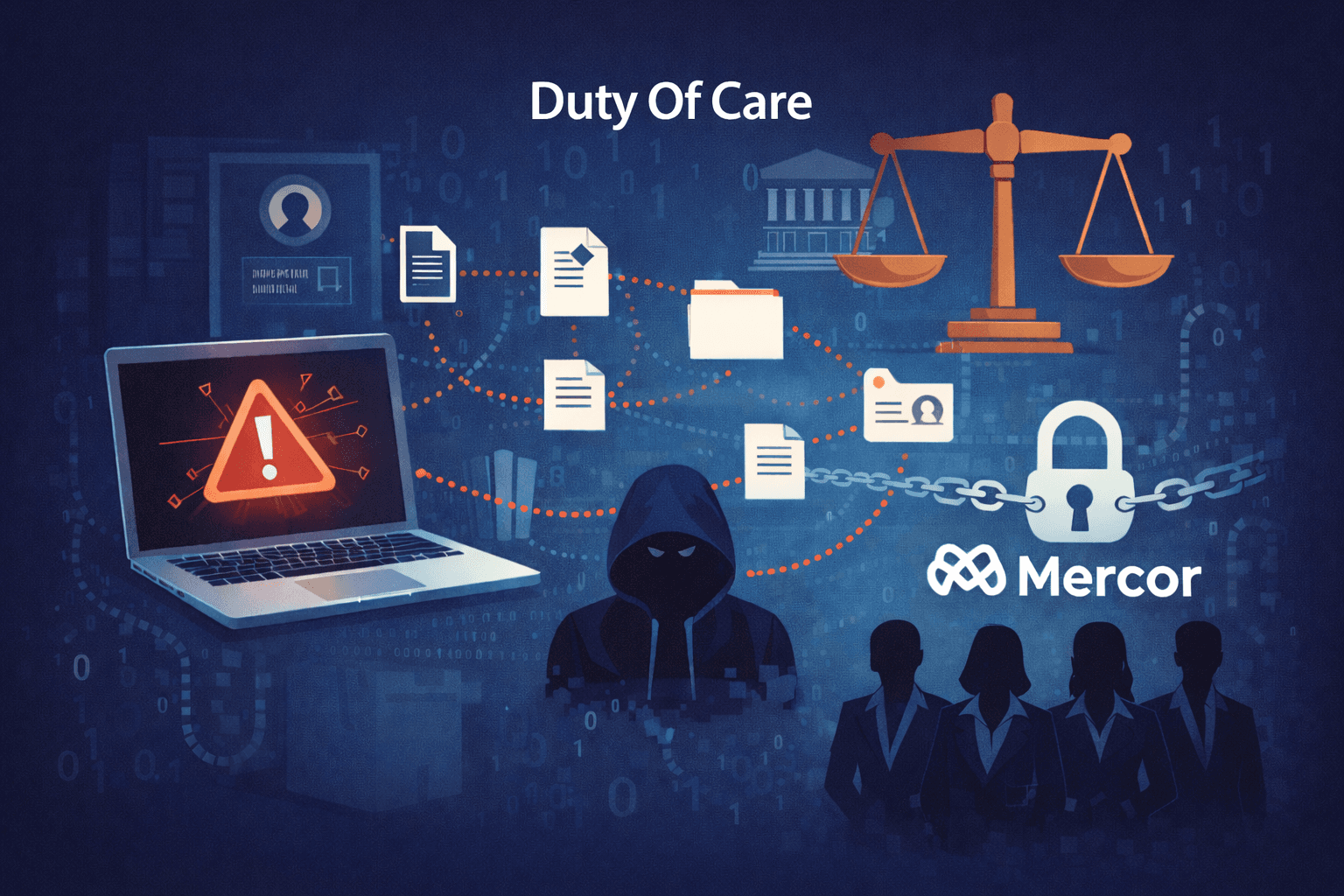
On March 31, 2026, one of Silicon Valley's most consequential data breaches was confirmed. Mercor, a $10 billion AI training startup serving OpenAI, Anthropic, and Meta, had 4 terabytes of data stolen. Forty thousand contractors had their personal data exposed: Social Security numbers, identity documents, video interviews, proprietary source code. Meta indefinitely paused all work with the company. Five lawsuits were filed within a week. Frontier AI training methodologies representing what Y Combinator CEO Garry Tan described as "billions and billions of value" are now potentially in the hands of adversaries, with national security implications that are still being assessed.
The breach did not happen because Mercor's authentication failed. It did not happen because someone clicked a phishing link or violated a security policy. It happened because credentials were stolen through a compromised open-source dependency and once those credentials were in the hands of the attackers, there was nothing left to stop them. The data was fully accessible. The session looked legitimate. The systems behaved exactly as designed.
And that is precisely the problem.
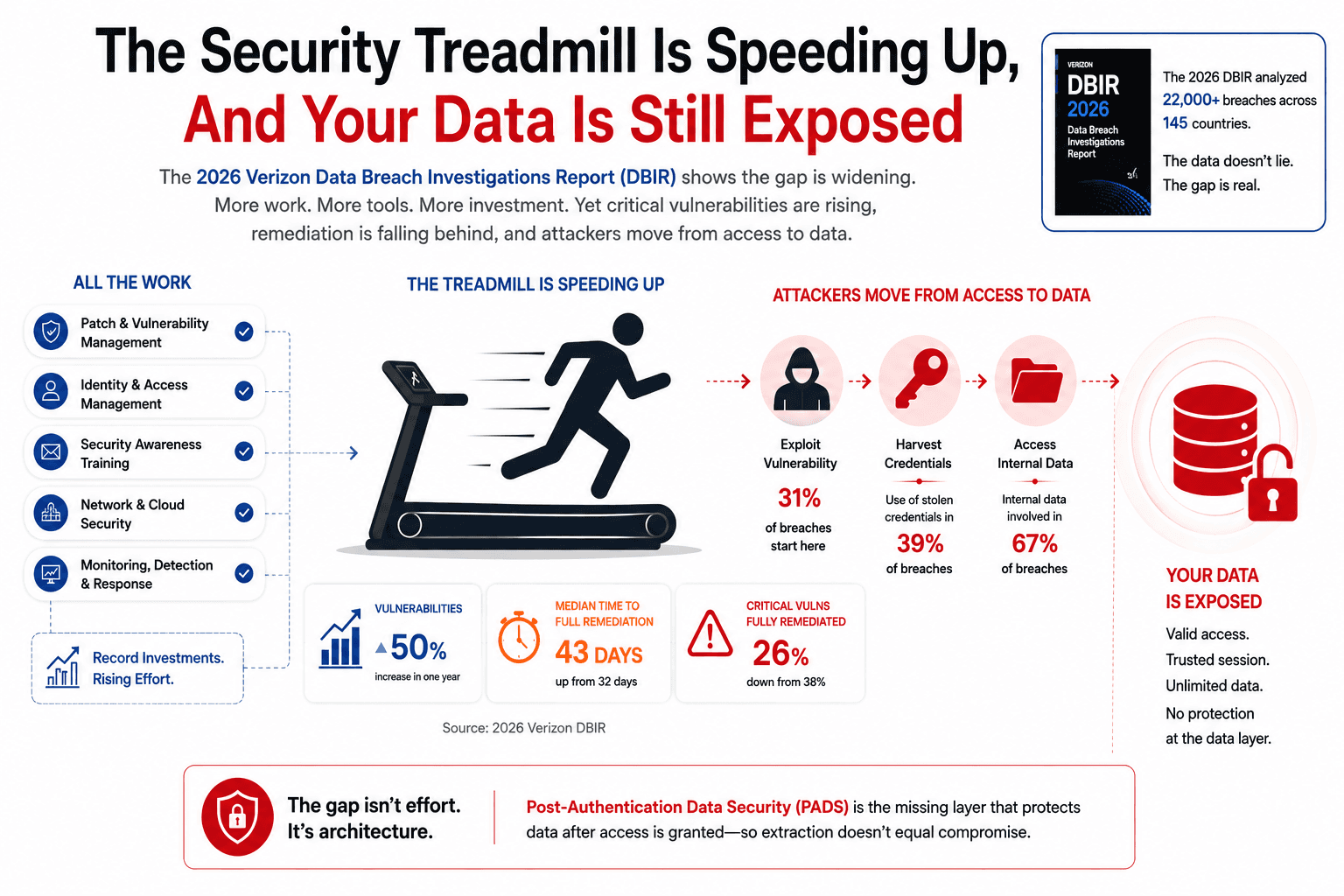
The cybersecurity industry has known for years that stolen credentials are the single biggest vulnerability in the modern security stack. This is not a controversial position. Verizon's Data Breach Investigations Report has identified compromised credentials as the leading cause of breaches for nearly a decade running. IBM's Cost of a Data Breach Report consistently ranks stolen credentials as both the most common and most expensive attack vector.
The industry has known this. It has known it for a long time. And it has continued to build security architectures that are fundamentally dependent on the integrity of those same credentials.
The Mercor breach is what that contradiction looks like at scale. And Post Authentication Data Security is the answer the industry has been missing.
The Modern Security Stack's Foundational Flaw
The modern security architecture is built around a single governing assumption: verify identity, grant access, trust the session. Every layer of the stack, firewalls, MFA, zero trust frameworks, PAM solutions, SIEM platforms, is designed to answer one question with increasing sophistication: is this the right person trying to get in?
It is a reasonable question. It is also the wrong one to be asking last.
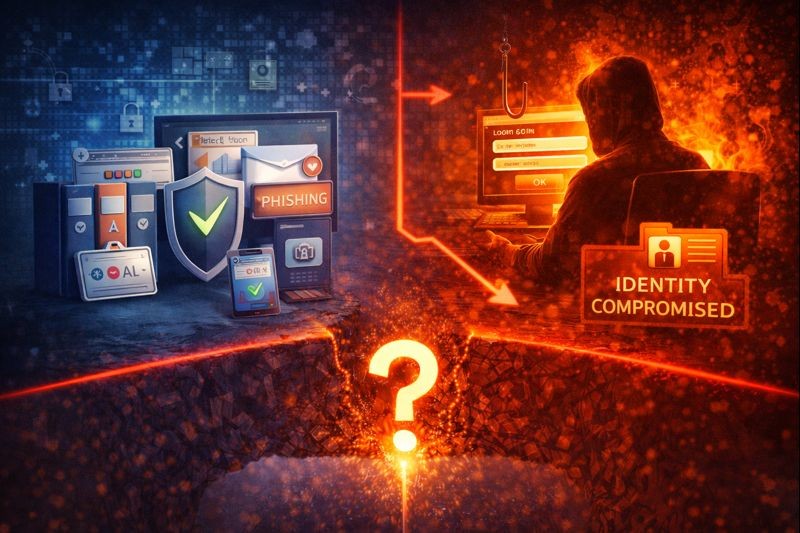
Because once the answer is yes, the architecture largely stops asking questions. The session is trusted. The permissions are valid. The data is accessible. And in a world where credentials can be stolen through a compromised open-source dependency executing in a CI/CD pipeline, without any human making a mistake, without any phishing email being clicked, without any policy being violated - the yes that unlocks everything can be obtained by anyone who controls the right piece of infrastructure at the right moment.
This is not a new vulnerability. It is the defining vulnerability of the modern security stack. Identity-centric security was the right answer to the perimeter problem of the 1990s and 2000s. It is an incomplete answer to the supply chain, insider threat, and credential theft problems of 2026.
The Mercor breach did not expose a gap nobody knew about. It exposed the gap everybody knew about and few have prioritized.
The Attack Did Exactly What Stolen Credentials Are Designed to Enable
To understand why Post Authentication Data Security matters here, it is worth being precise about what actually happened at Mercor.
The attackers did not break the authentication system. They did not forge identities or exploit a zero-day in an access management platform. Through a cascading supply chain attack originating in a compromised GitHub Actions workflow in an open-source vulnerability scanner called Trivy, threat group TeamPCP harvested legitimate credentials - API keys, cloud tokens, SSH keys, database passwords, Kubernetes secrets - and used them to access Mercor's systems exactly as those systems were designed to be accessed.
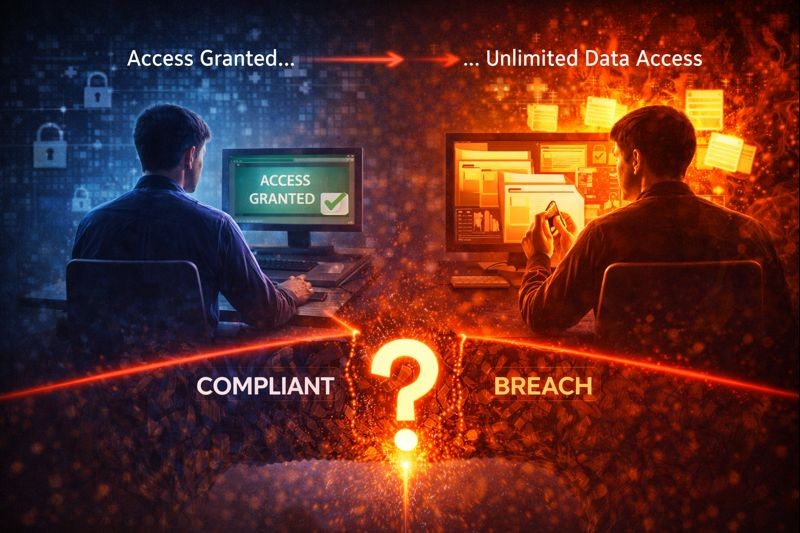
From the perspective of every access control in Mercor's stack, the session was valid. The permissions were legitimate. The activity looked correct. The system behaved exactly as designed.
And 4 terabytes of data was taken.
This is the Post Authentication Data Security gap in its most devastating form. The entire security architecture was designed to answer one question: should this entity be allowed in? Once the answer was yes, the data was fully exposed. There was nothing governing what happened to it after authentication succeeded.
The attackers walked in through the front door with a stolen key, picked up everything of value, and walked out. The door worked exactly as designed. That was the problem.
What Post Authentication Data Security Would Have Changed
Post Authentication Data Security operates on a fundamentally different principle than every other layer of the security stack. It does not try to keep attackers out. It accepts the reality that credentials will be stolen, the industry's own data confirms this repeatedly, and makes the data itself the last line of defense, rendering it useless to anyone who extracts it without authorization, regardless of how they obtained access.
In the Mercor scenario, Post Authentication Data Security would have intervened at the moment that mattered most: when stolen credentials were used to access and exfiltrate sensitive data.
Contractor PII - Social Security numbers, identity documents, W-9 forms - would have been encrypted at the file layer. Stolen credentials would have retrieved encrypted files. Without the corresponding decryption keys tied to legitimate authorized users in authorized contexts, the data would have been worthless. The 211 GB user database and the personal records of 40,000 contractors would have been unreadable noise.
The 939 GB of proprietary source code would have been protected in the same way. The stolen credentials provided access to the files. Post Authentication Data Security ensures that access and readability are not the same thing. You can reach the file. You cannot read it.
The 3 terabytes of video interview recordings - among the most sensitive and personally identifiable content in the breach - would have been encrypted at rest and remained encrypted through exfiltration regardless of what credentials were used to retrieve them.
The AI training methodologies that represent the deepest strategic exposure in this breach - the data selection criteria, labeling protocols, and RLHF training strategies that Garry Tan described as a national security issue - would have been governed at the data layer, not just the access layer. Extracting them would have produced encrypted files that serve no intelligence value whatsoever.
The attackers had valid stolen credentials. Post Authentication Data Security ensures that valid credentials are not sufficient to weaponize data.
The Compliance Dimension Changes Completely
One of the most damaging aspects of the Mercor breach is its regulatory and legal exposure. Five lawsuits filed within a week. GDPR implications across multiple jurisdictions. SEC disclosure obligations. Contractor notification requirements for 40,000 individuals across multiple countries.
This is where Post Authentication Data Security does something no other security control can claim: it has the potential to eliminate the reportable breach event entirely.
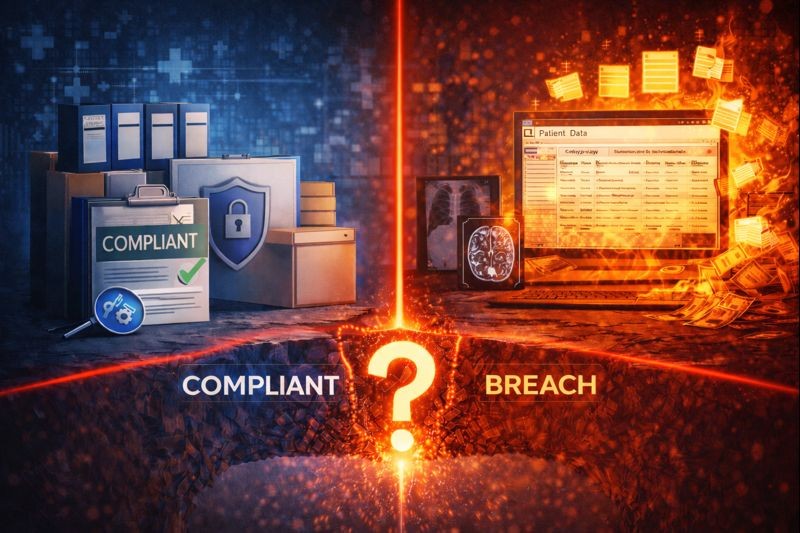
Most data breach notification laws, GDPR, HIPAA, and the majority of US state frameworks, are triggered by the exposure of usable, readable personal data. GDPR Article 34 explicitly states that notification to affected individuals is not required when data was encrypted and rendered unintelligible to unauthorized parties. HIPAA's Safe Harbor provision categorizes encrypted breached data as a non-reportable event. California's CCPA, New York's SHIELD Act, and most equivalent frameworks include explicit encryption safe harbors.
If Mercor's contractor data had been protected at the file layer, the legal analysis shifts dramatically. The attackers exfiltrated encrypted files. No personal data was exposed in a usable form. The threshold for mandatory customer notification may not have been crossed. The basis for class action litigation, that sensitive personal data was compromised and can now be exploited, largely disappears.
The five lawsuits filed against Mercor are predicated on the data being accessible and harmful. Encrypted data that cannot be read is not harmful in the legal sense that drives litigation. Mercor's $10 billion valuation and its relationships with the most important AI companies in the world may have survived intact.
This reframes the entire conversation for the CEO, General Counsel, and Chief Risk Officer simultaneously. Post Authentication Data Security is not just a security investment. It is litigation prevention, regulatory protection, and reputational preservation - delivered through a technical control that operates independent of whether the credentials protecting it were ever compromised.
The Delve Scandal Reveals the Deeper Problem
The compliance layer in this breach deserves its own examination because it speaks directly to why Post Authentication Data Security is not just useful but essential.
Delve Technologies had certified LiteLLM's security compliance. Those certifications were, according to the whistleblower who exposed the company, industrialized fiction. Pre-populated attestations generated before any independent review occurred, issued by certification mills operating through front companies, covering security controls that were never actually verified.
But here is what the Delve scandal actually reveals about the industry's credential problem: the compliance frameworks Delve was certifying against all include extensive identity and access controls. MFA requirements. Privileged access management. Credential rotation policies. Session monitoring. Organizations were certifying that these controls existed. In Delve's case they were certifying it without verification. But even when certifications are legitimate, they certify the existence of access controls but not the invulnerability of the credentials those controls protect.
The industry has built a compliance infrastructure that validates the door. It has not built one that protects what is behind it when the key is stolen.
Post Authentication Data Security provides something compliance frameworks cannot: protection that is self-executing rather than self-attesting. A company protected at the data layer does not need an auditor to certify that its data is encrypted. The data is encrypted. If it is stolen, it is unreadable. The protection is not a document. It is a technical fact that holds regardless of whether the credentials protecting it were compromised.
In a post-Delve world where compliance certifications have been exposed as potentially worthless, the only meaningful security guarantee is one that operates independent of human attestation. Post Authentication Data Security is that guarantee at the data layer.
The Supply Chain Problem Has No Credential Solution
The most important structural lesson of the Mercor breach is one the security industry has been reluctant to confront directly: the attack surface for credential theft has expanded beyond any organization's ability to fully control it.
The attack chain began with Trivy, an open-source vulnerability scanner trusted by millions of organizations. It moved through LiteLLM, present in an estimated 36% of all cloud environments. It reached Mercor through a CI/CD pipeline executing code that had been legitimate the day before. At every step, the access was authenticated. The credentials were valid. The systems behaved exactly as designed.
No identity platform, no MFA implementation, no zero trust architecture can fully protect against credential theft that occurs outside your environment - in a dependency, in a pipeline, in infrastructure you do not own and cannot directly audit. Mandiant CTO Charles Carmakal reported at RSAC 2026 that over 1,000 SaaS environments were actively dealing with cascading effects from these attacks. Suzu Labs Senior Director Jacob Krell described the mechanics precisely: one dependency, one chain reaction, five supply chain ecosystems compromised in under a month.
Okta's VP of Threat Intelligence connected it to identity debt created by rapid AI agent adoption, where developers repeatedly connect AI agents directly to production applications using static API tokens. The credential surface is not shrinking. It is expanding faster than any identity-centric control framework can track.
The industry's response has been to improve credential hygiene, rotate tokens more frequently, pin dependencies, and implement better monitoring. All of that is correct and necessary. None of it changes the fundamental reality that in a sufficiently complex modern environment, credential compromise is not a failure to be prevented, it is an eventuality to be survived.
Post Authentication Data Security is how you survive it. It does not assume the integrity of the credential. It does not rely on the pipeline. It does not depend on the compliance certification. It makes the data unreadable to anyone who cannot prove, at the moment of access, that they are the authorized user in an authorized context, independent of whether the credential they used was legitimately obtained.
This Is Not a Security Conversation Anymore
The Mercor breach produced five lawsuits in one week. It caused Meta to pause all work with a key AI training partner. It exposed the personal data of 40,000 individuals across multiple jurisdictions. It potentially compromised frontier AI training methodologies representing billions in strategic value. It contributed to the collapse of a $300 million compliance startup.
The industry knew stolen credentials were the primary attack vector. It has known for years. The response has been to build better identity controls, stronger access management, and more sophisticated authentication. Those investments are not wasted. They are necessary. But they are insufficient because they all share the same foundational dependency: the integrity of the credential itself.
When the credential is compromised, and in a world of cascading supply chain attacks, it will be, the identity-centric stack has no further answer. The data is exposed. The breach is real. The lawsuits follow.
Post Authentication Data Security is the answer the industry has been missing. Not a replacement for identity and access management. A necessary complement to it that closes the gap every security professional already knows exists. The layer that activates precisely when everything else has already failed.
The Mercor breach is not a warning about what could happen. It is a demonstration of what happens, repeatedly, at scale, with accelerating consequences, when organizations protect the credential and leave the data undefended.
The credential will be stolen. The only question is whether the data it unlocks can be weaponized when it is.
Post Authentication Data Security ensures the answer is no.
FenixPyre is purpose-built to close the Post Authentication Data Security gap - ensuring that data remains protected at the file layer regardless of how access was obtained. In a world where supply chain attacks make credential theft an inevitability, PADS is not a security enhancement. It is the control the modern stack was always missing.



solutions

© 2018-2026 FenixPyre Inc, All rights reserved
solutions
7775 Walton Parkway
Suite 224
New Albany, OH 43054
© 2018-2026 FenixPyre Inc, All rights reserved
solutions
7775 Walton Parkway
Suite 224
New Albany, OH 43054
© 2018-2026 FenixPyre Inc, All rights reserved