In the week of April 1 through April 7, 2026, five class action lawsuits were filed against Mercor, a $10 billion AI training startup serving OpenAI, Anthropic, and Meta. Five lawsuits in seven days. Each one built around the same fundamental argument - that Mercor failed to implement adequate security measures to protect the sensitive data of more than 40,000 contractors whose personal information, professional work product, and identifying documents were stolen in one of the most consequential data breaches of 2026.
The plaintiffs are not wrong that a failure occurred. The breach was real. The harm is real. The stolen data - 939 gigabytes of proprietary source code, 3 terabytes of video interview recordings and identity verification documents, a 211 gigabyte user database, internal communications, and AI training methodologies that Y Combinator CEO Garry Tan described as representing billions in value and a major national security issue - is now in the hands of attackers who obtained it through a cascading supply chain attack that harvested legitimate credentials from a compromised open source dependency.
The lawsuits are right that Mercor failed. They are wrong about what that failure actually was. And in being wrong about that, they are asking for a legal remedy built on a standard of care argument that - even if fully satisfied - would not have protected a single file when the credentials were compromised.
That is not a minor procedural deficiency. It is a fundamental misidentification of the duty that was breached. And it matters enormously - not just for the 40,000 contractors who deserve meaningful remedy, but for every organization that will read the Mercor settlement, implement its required controls, and believe they have met their obligation to protect the people whose data they hold.
They will not have. And the next breach will prove it.
The Standard of Care Argument the Lawsuits Are Building
To understand why the lawsuits are asking for the wrong fix it is necessary to understand precisely what legal standard they are invoking and where that standard falls short.
Data breach class actions in the United States are predominantly built on negligence theory. To succeed on a negligence claim a plaintiff must establish that the defendant owed a duty of care, that the defendant breached that duty, that the breach caused the plaintiff's harm, and that the plaintiff suffered cognizable damages.
The duty of care in data breach cases has been progressively defined by courts, regulators, and compliance frameworks over the past two decades. The FTC has enforcement authority over unfair or deceptive data security practices. The SEC has specific guidance for registered investment advisers and technology companies on data protection obligations. State attorneys general have brought actions under consumer protection statutes. Courts have increasingly recognized an implicit duty to protect sensitive personal data commensurate with the nature of the data held and the reasonable expectations of the people who provided it.
What has emerged from this body of law, regulation, and enforcement is a standard of care built almost entirely around access layer controls. The duty as courts and regulators currently understand it is a duty to prevent unauthorized access. Implement MFA. Segment networks. Monitor for anomalous activity. Rotate credentials. Conduct regular security audits. Encrypt data at rest and in transit.
The Mercor lawsuits invoke exactly this standard. The Gill complaint alleges failure to implement MFA, failure to limit access to PII, failure to monitor systems, failure to rotate passwords, and failure to encrypt sensitive data during storage and transmission. It is a textbook recitation of the access layer standard of care as it currently exists in data breach litigation doctrine.
And here is the legal problem that nobody in any of the five courtrooms is currently confronting:
That standard of care - even fully satisfied - would not have prevented the harm the plaintiffs suffered. Because the harm did not originate from a failure of access layer controls. It originated from a failure at the data layer. And the legal doctrine has not yet caught up to that distinction.
The Encryption Allegation Points at the Right Problem and Then Misses It
Among all the allegations in the Mercor complaints, the failure to encrypt sensitive data during storage and transmission is the one that comes closest to identifying the actual duty that was breached. It points toward the right problem. But the way it is framed - listed alongside MFA and password rotation as one item among several access layer improvements - reveals that the plaintiff's attorneys understand encryption as a storage security measure rather than as a fundamentally different category of data protection obligation.
That distinction is not semantic. It is the difference between a remedy that changes the outcome for 40,000 contractors and a remedy that produces a more expensive breach with identical consequences.
Encryption at rest means data sitting in a database or storage system is encrypted when it is not being accessed. Encryption in transit means data moving between systems is encrypted as it travels. Both are legitimate and important security controls. Both are widely recognized components of the current standard of care. And both are rendered completely ineffective the moment an attacker obtains valid credentials - because when a user authenticates through the normal access pathway the system decrypts the data for them, it cannot distinguish between a legitimate user and an attacker holding stolen credentials, and the encryption that was supposed to protect the data dissolves on contact with a valid authenticated session. In the exact breach scenario the Mercor lawsuits describe, both controls perform exactly as designed and protect nothing.
This means that in the exact breach scenario the Mercor lawsuits describe - an attacker authenticating successfully with stolen credentials and accessing files through the authorized decryption pathway - both forms of encryption the complaint demands would have been fully satisfied and would have protected nothing. The files would still have been usable. The exfiltration would still have proceeded. The harm would still have flowed to 40,000 contractors.
The lawsuits are demanding a standard of care that has already been implicitly satisfied by the mechanism of the attack itself. And demanding it more rigorously produces no meaningful benefit to the people the litigation is supposed to protect.
The Duty That Was Actually Breached
If the current standard of care - even fully implemented - would not have changed the outcome, the legal question becomes what duty would have. What obligation, if discharged, would have rendered the breach consequence-free for the 40,000 contractors who are now plaintiffs?
The answer is precise and it points to a duty that existing doctrine has not yet adequately articulated: the duty to protect data at the file layer after authentication succeeds.
This is the Post Authentication Data Security duty. It is distinct from and more demanding than the access layer duty that current doctrine recognizes. It is not a duty to prevent unauthorized access - though that duty exists and matters. It is a duty to ensure that data remains protected even when access succeeds, whether that access was legitimately obtained or achieved through credential theft, supply chain compromise, insider misuse, or any other vector that produces a valid authenticated session.
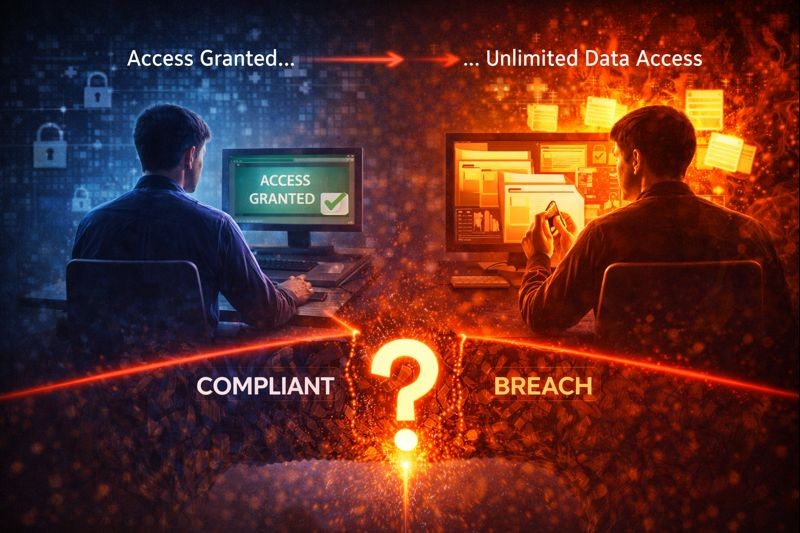
The distinction maps directly onto the facts of the Mercor breach. The attackers authenticated successfully. Every access control performed exactly as designed. The breach did not occur at the access layer - it occurred at the data layer, where no protection existed to govern what happened to files after authentication succeeded.
Under the current standard of care doctrine, Mercor's failure is characterized as an access layer failure - insufficient MFA, inadequate monitoring, poor credential hygiene. Those characterizations may be legally valid but they are factually incomplete. The more precise and more legally significant failure was the absence of file layer protection that would have rendered the authenticated access consequence-free regardless of who held the credentials.
The duty to protect data at the file layer after authentication succeeds is the duty the Mercor lawsuits are gesturing toward but failing to name. And naming it precisely is the most important legal contribution the Mercor litigation could make to the evolution of data breach doctrine.
Why the Current Standard of Care Is Structurally Insufficient
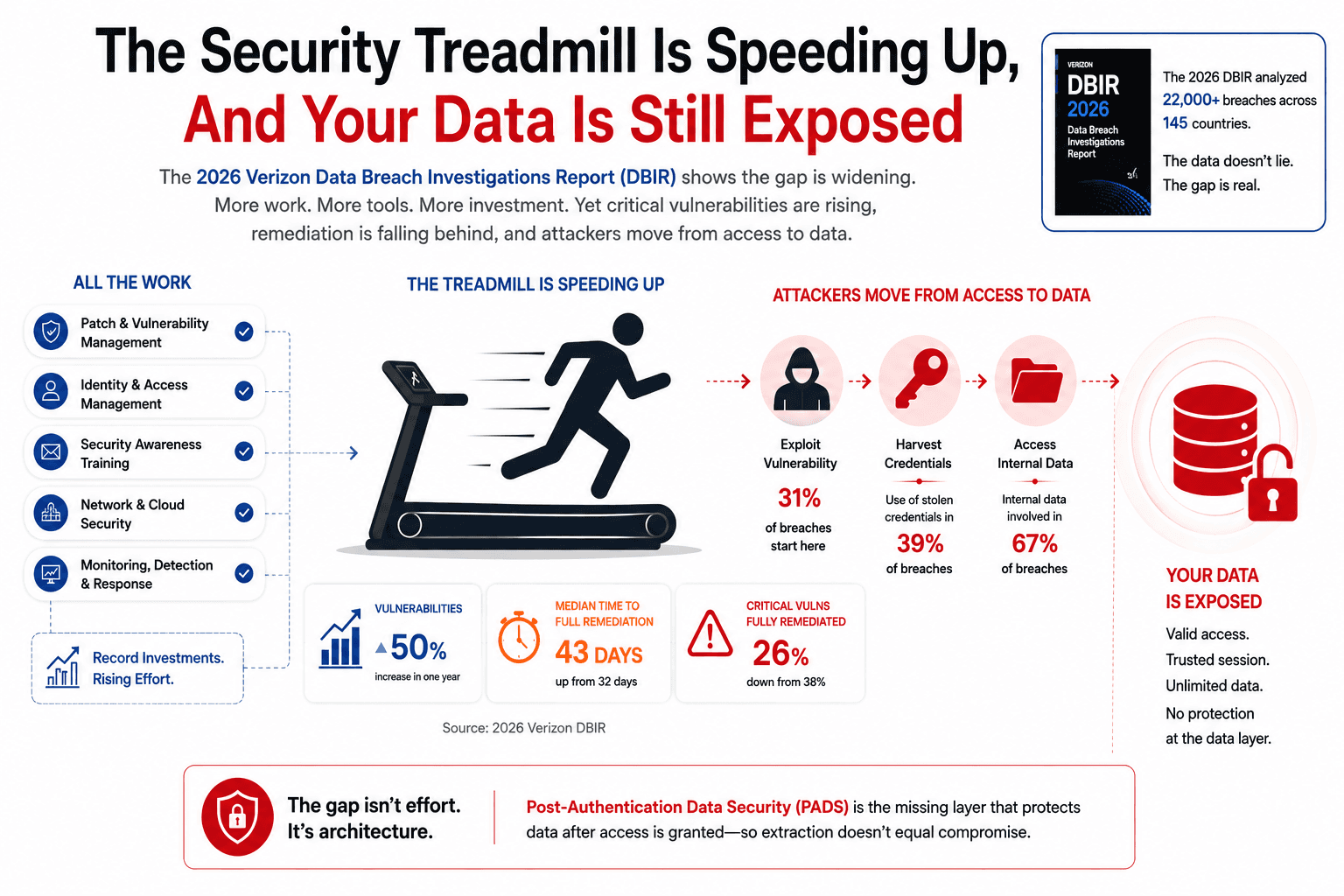
The cybersecurity industry has known for years that stolen credentials are the single biggest vulnerability in the modern security stack. This is not a controversial position. Verizon's Data Breach Investigations Report has identified compromised credentials as the leading cause of breaches for nearly a decade running. IBM's Cost of a Data Breach Report consistently ranks stolen credentials as both the most common and most expensive attack vector. Every major security framework - NIST, ISO 27001, HITRUST - includes extensive controls around identity and access precisely because the industry understands that when credentials are compromised, everything built around them collapses.
The cybersecurity industry has known this. It has known it for a long time. And it has continued to build and sell architectures that are fundamentally dependent on the integrity of those same credentials - producing a decade of breach reports confirming the problem while simultaneously recommending the same access layer controls that the breach reports prove are insufficient.
That failure has a direct legal consequence. Courts and regulators developing the standard of care in data breach cases have done what courts and regulators reasonably do - they have looked to the security industry for guidance on what constitutes reasonable practice. The standard of care that has emerged reflects the industry consensus those courts and regulators found when they looked. A perimeter-centric, access-focused framework that treats credential integrity as the primary and in many cases sufficient protection for sensitive data.
The doctrine is not wrong on its own terms. It accurately reflects what the industry told courts and regulators was adequate. The problem is that the industry's own data has been contradicting that consensus for years - and the legal standard has had no mechanism to update itself in response. The result is a standard of care that courts apply in good faith, that organizations implement in good faith, and that leaves sensitive unstructured files fully exposed to the primary attack vector the industry itself has identified as the leading cause of breaches for nearly a decade.
That is not a gap in legal reasoning. It is a gap between legal doctrine and technical reality - and it is a gap that the Mercor breach has rendered impossible to ignore.
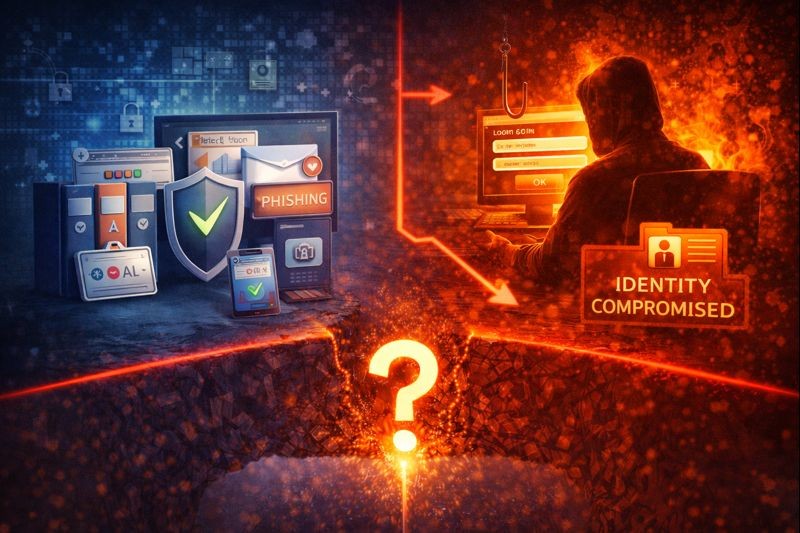
The Mercor breach is the most precise possible illustration of that gap. The attack chain began with a compromised GitHub Actions workflow in an open source vulnerability scanner. It harvested credentials through a malicious dependency executing in a CI/CD pipeline. It used those credentials to authenticate as legitimate users. It accessed and exfiltrated files that the authenticated session was authorized to access. Every step of that chain operated entirely within the parameters of a security architecture that meets the current standard of care.
The standard of care that the Mercor lawsuits are invoking - the standard that Mercor allegedly failed to meet - would not have detected or prevented any step of that chain after the initial credential harvest. Because the standard is designed around preventing unauthorized access and the attack succeeded by achieving authorized access with stolen credentials.
A standard of care that cannot address the primary attack vector in the industry's own breach data is not a standard that adequately defines the duty organizations owe to the people whose data they hold.
What the Evolved Standard of Care Looks Like
The legal evolution that the Mercor lawsuits should be driving - but are not yet articulating - is a standard of care that extends the duty of protection beyond the access layer to the data layer itself.
Under an evolved standard the duty is not satisfied by encrypting data at rest and in transit. Those controls protect data from passive interception and storage compromise. They do not protect data from authenticated access using stolen credentials. They do not protect files from exfiltration by a session that the system has recognized and authorized. They are necessary components of a complete security posture but they are not sufficient to discharge the duty of care owed to people whose most sensitive personal and professional information is held in unstructured files.
The evolved standard requires file layer protection - encryption that travels with the file itself, that governs usability independent of the access layer, that remains in force regardless of what credentials were used to obtain access, and that renders the file unusable to any recipient who cannot demonstrate, at the moment of access, that they are the authorized user in the authorized context for which access was intended.
This is Post Authentication Data Security applied as a legal duty rather than a security recommendation. It is the control that, had it been in place at Mercor, would have changed the outcome completely.
The attackers authenticated successfully. They accessed the files. They exfiltrated the files. And the files were ciphertext. Not because the authentication failed. Not because the access was detected and blocked. But because the files themselves were protected in a way that made the authenticated access consequence-free for every contractor whose data was taken.
Under an evolved standard of care that recognized this duty, Mercor's failure was not that it lacked adequate MFA or insufficient password rotation. It is that it held 40,000 people's most sensitive data in unprotected files that were fully usable to anyone who obtained valid credentials - and in a world where credential theft through supply chain compromise is the industry's leading breach vector, holding sensitive data in unprotected files is itself the breach of duty.
The Delve Scandal Proves the Point
The Mercor breach did not happen in isolation. It happened simultaneously with the exposure of Delve Technologies - the GRC automation startup that had issued compliance certifications for LiteLLM, the open source AI proxy whose compromise enabled the credential harvest that reached Mercor. Those certifications were, according to the whistleblower who exposed the company, industrialized fiction. Pre-populated attestations. Certifications issued without independent verification of the controls they purported to certify.
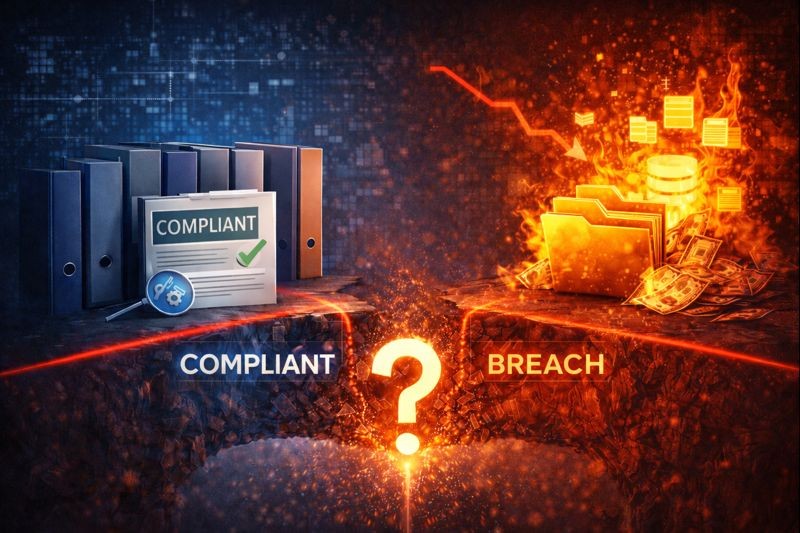
The convergence of these two stories is not incidental. It is the most powerful possible illustration of the gap between certified compliance and actual data protection that sits at the heart of the standard of care problem.
Mercor had compliance certifications. LiteLLM had compliance certifications. Those certifications validated access controls, security processes, and organizational security practices against the current standard of care. And none of it protected a single file when the credentials were compromised.
This is the standard of care problem rendered in its starkest form. The compliance framework the lawsuits are demanding Mercor should have met is a framework designed to certify access controls. It has no mechanism for certifying what happens to files after access succeeds. It validates the door. It has nothing to say about the files behind the door when someone walks through with a stolen key.
The Delve scandal did not create this problem. It exposed it. The problem existed in every legitimately certified organization whose sensitive files are protected only by the access controls that a valid authenticated session bypasses by definition. The certification confirms the lock works. It says nothing about the readability of what is inside when the lock is opened with a stolen key.
Post Authentication Data Security provides the protection that certification cannot - because it is not a process control that can be attested to. It is a technical control that either renders files unusable or does not. There is no compliance theater version of file layer encryption. The files are either protected or they are not. And that binary self-executing reality is precisely what the evolved standard of care should require.
The Regulatory Safe Harbor Argument
The legal implications of file layer protection extend beyond negligence theory into the regulatory framework that governs breach notification and penalty - and here the argument for an evolved standard of care becomes most immediately actionable for organizations deciding right now how to protect the files they hold.
Most data breach notification laws are triggered by the exposure of usable readable personal data. GDPR Article 34 explicitly states that notification to affected individuals is not required when data was encrypted and rendered unintelligible to unauthorized parties. HIPAA's Safe Harbor provision categorizes encrypted breached data as a non-reportable event. California's CCPA, New York's SHIELD Act, and most equivalent state frameworks include explicit encryption safe harbors that reduce or eliminate notification obligations when stolen data was encrypted and ciphertext.
These safe harbors already exist in the regulatory framework. They already recognize that encrypted data that cannot be read does not produce the harm that breach notification laws are designed to address. They are the regulatory system's implicit acknowledgment of the principle that Post Authentication Data Security makes explicit - that what matters for data protection purposes is not whether the data was accessed but whether it was usable when it was taken.
The Mercor lawsuits are built on the premise that contractor data was compromised in a readable form. Under the regulatory safe harbor framework that already exists, file layer encrypted data that is exfiltrated but unusable does not meet the threshold for mandatory notification. The breach event that generates the legal obligation does not occur. The five lawsuits have no viable plaintiff because the harm the plaintiffs allege - exposure of readable personal data to criminal actors who can exploit it - has not occurred.
The safe harbor framework is the regulatory system pointing toward the evolved standard of care that litigation doctrine has not yet fully articulated. It already recognizes that encryption at the data layer changes the legal character of a breach. The doctrinal evolution required is to extend that recognition from a regulatory safe harbor into an affirmative duty - a standard of care that requires file layer protection not merely as a mitigating factor but as a component of the baseline obligation owed to people whose sensitive data is held in unstructured files.
What the Mercor Lawsuits Should Be Arguing
The most important legal contribution the Mercor litigation could make is to reframe the standard of care claim around the duty that was actually breached rather than the duty that existing doctrine recognizes.
The complaint should not lead with failure to implement MFA or failure to rotate passwords. Those are real failures and they belong in the complaint. But they are not the failure that made 40,000 contractors vulnerable to years of identity theft risk. The failure that did that was holding sensitive unstructured files - files containing Social Security numbers, identity documents, video recordings, and proprietary work product - without file layer protection that would have rendered those files unreadable to anyone who took them regardless of what credentials they used.
The encryption allegation in the current complaint points toward this duty but frames it as a storage security failure. The stronger and more legally significant framing is a failure of Post Authentication Data Security - a failure to protect files at the data layer in a way that maintains protection after authentication succeeds, independent of credential integrity, independent of access layer controls, independent of whether the session that accessed the files was legitimate or the product of supply chain credential theft.
That framing advances data breach doctrine in a meaningful direction. It creates a legal framework that actually maps onto the threat environment the industry's own data describes - a world in which credential compromise is the leading attack vector and access layer controls are necessary but insufficient to discharge the duty of care owed to the people whose data is at risk.
It also creates a remedy that would actually change the outcome. Not a settlement requiring better MFA and more rigorous password rotation that leaves 40,000 people's files just as usable the next time valid credentials are stolen. A standard that requires file layer protection - protection that holds when everything else fails, protection that renders credential theft consequence-free for the people whose data was taken.
The Conversation the Industry and the Legal Community Must Have Together
The Mercor lawsuits will settle. The settlement will specify controls. The controls will reflect the current standard of care. And the current standard of care will remain a decade behind the threat environment it is supposed to address.
Unless the legal community starts asking the question that the complaints are currently missing.
Not whether Mercor had adequate access controls. Whether Mercor discharged its duty to protect the files its contractors trusted it to hold - protect them in a way that maintains that protection after authentication succeeds, that holds when credentials are stolen, that renders the breach consequence-free for the people whose data is taken regardless of how the attacker obtained access.
That is the standard the threat environment demands. That is the standard the regulatory safe harbor framework is already gesturing toward. That is the standard the evolved duty of care in data breach litigation needs to articulate.
Post Authentication Data Security is not the standard of care today. It is the standard of care the Mercor breach demonstrates is necessary - and the standard that the legal community, the security industry, and the organizations that hold sensitive unstructured files have a shared obligation to establish before the next breach proves the same point at the same cost to the same people who had no choice but to trust that the files they handed over would be protected when it mattered most.
The five lawsuits filed in seven days are the most powerful available argument for why that conversation cannot wait.
FenixPyre is purpose-built to close the Post Authentication Data Security gap for unstructured data - ensuring that files remain protected at the data layer regardless of how access was obtained. In a world where supply chain attacks make credential theft an inevitability, file layer protection is not a security enhancement. It is the evolved standard of care the modern threat environment demands.